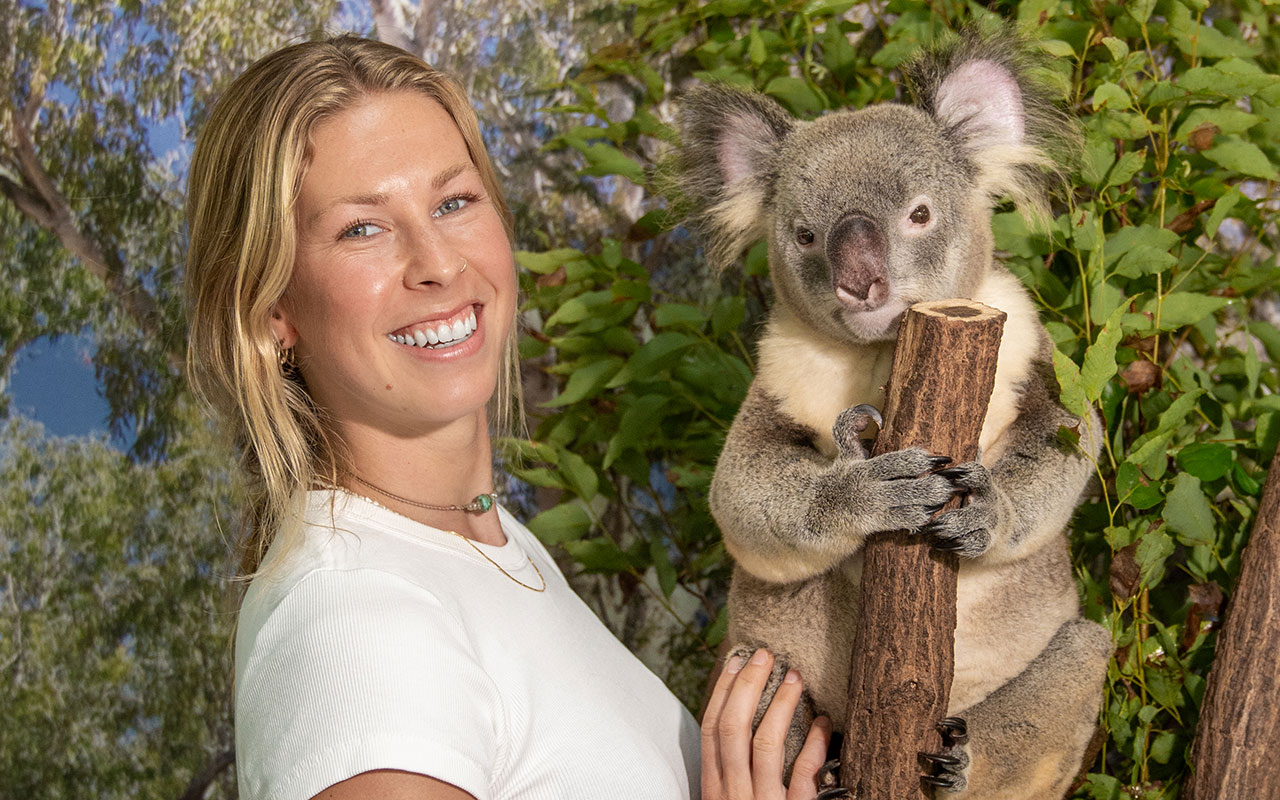


Stand next to one of our koalas and give it a pat for a unique souvenir photo. Available for singles.
11am, 12pm, 1pm & 2.30pm Daily

Your family can enjoy a wonderful koala encounter with a souvenir photo. Available for groups of between 2 – 5 people, friends and families.
11am, 12pm, 1pm & 2.30pm Daily

Hold one of our friendly pythons for a memorable souvenir photo. Available for singles.
11am to 2.30pm Daily

The price for our souvenir wildlife photos includes a printed copy of your photo, which is presented in a souvenir folder, as well as a digital download of your photo for free, which is great for sharing with friends and family. Please allow up to 12 hours for the photos to be uploaded.
: Processing color images using the RGB model can be counterintuitive because changing one channel affects both brightness and color. Jayaraman recommends transforming images to the HSI color space for tasks like color segmentation, as it decouples color information from brightness. Module 7: Image Compression Techniques Slide 16: Fundamentals of Image Compression Content :
Mean filters (Arithmetic, Geometric, Harmonic) and Order-statistics filters (Median, Max, Min, Midpoint).
The Jayaraman text emphasizes the practical utility of these techniques in various fields: CT scans, MRI, and X-ray analysis.
Dilation followed by erosion; fuses narrow breaks and fills long thin gulfs. Image Segmentation
Results from the structural correlations between neighboring pixels. digital image processing jayaraman ppt
: Involves "making sense" of an ensemble of recognized objects, as in image analysis and computer vision. 2. Fundamental Steps in Digital Image Processing
g(x,y)=T[f(x,y)]g of open paren x comma y close paren equals cap T open bracket f of open paren x comma y close paren close bracket is the input image, is the processed image, and is an operator on defined over a neighborhood of 2.1 Basic Gray Level Transformations
: Transforming segmented data into a form suitable for computer processing. Representation decides whether data should be represented as a boundary or a complete region; description deals with extracting quantitative features (descriptors).
High-resolution monitors utilized for visualization. 2. Fundamental Steps in Digital Image Processing : Processing color images using the RGB model
(25–30 slides)
: Mathematical foundations including 2D convolution, Z-transforms, and popular image transforms like Fourier or Discrete Cosine Transform (DCT) .
To make this review even more helpful for your studies or teaching preparation, please
: Representing images in various degrees of resolution, which is highly useful for data compression. The Jayaraman text emphasizes the practical utility of
This step extracts image components useful for representing and describing region shapes. Core operations include: Expands the boundaries of foreground objects. Erosion: Shrinks the boundaries of foreground objects.
Transform Coding (Discrete Cosine Transform used in standard JPEG format) and Wavelet-based compression. Chapter 8: Image Segmentation
Digital Image Processing (DIP) is a cornerstone technology in modern engineering, enabling computers to analyze, enhance, and interpret visual data. Among the many resources available for learning this subject, the materials based on the textbook "Digital Image Processing" by S. Jayaraman, S. Esakkirajan, and T. Veerakumar (often referred to as the ) are highly regarded for their clarity, structure, and comprehensive coverage of the field.
Dedicated hardware for fast processing.
A digital image is defined as a two-dimensional function, ( f(x, y) ), where ( x ) and ( y ) are spatial coordinates and the amplitude of ( f ) at any point is the or gray level of the image at that point. A digital image is essentially a matrix of numbers, where each number is called a pixel , and the image is created when the ( x, y ) and amplitude values are all finite, discrete quantities.
Spatial resolution is determined by sampling (dots per inch, pixels).
© Kuranda Koala Gardens 2026