Hippo is a personal CRM built for Apple platforms. Keep notes, events, and to-dos for the friends, family, and colleagues you care about — all stored on your device. No account. No cloud server. No Contacts permission required.
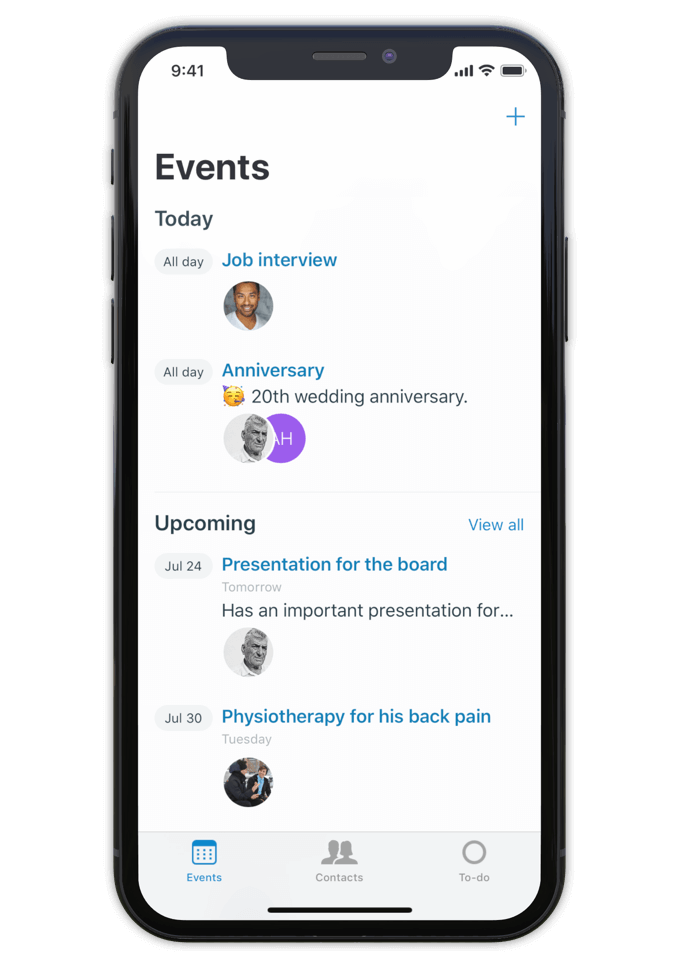
Hippo is a personal CRM for iPhone, iPad, and Mac. A personal CRM helps you keep track of the people in your life the way a sales CRM helps a salesperson track leads — but focused on the relationships that actually matter to you. Friends, family, mentors, colleagues, the people you want to stay close to.
Unlike most personal CRMs, Hippo stores everything on your device. There’s no account to sign up for, no server holding your contacts, and access to your iOS Contacts list is never required (it’s optional, and granted contacts still stay on-device). Optional sync runs through your own private iCloud Drive — never through Hippo.
Hippo is built for people who want to be more attentive without trading their privacy for the privilege.
Make notes, keep track of events and store to-dos for all your contacts.
So next time you meet, a quick glance at the person's profile in Hippo is all you need to remember the details.
Being attentive doesn’t have to be a challenge anymore.
Hippo is your personal reminder.

Use notes to quickly jot down things you learned about your contacts. Like names of kids, new jobs, a promotion, holiday plans, or gift ideas.
Create events for face to face meetings or important life events.
Get reminded when the event is happening so you can ask about it.
Remember the questions you want to ask the next time you meet.
Hippo is the personal CRM that doesn’t want your data.

Monica is a powerful open-source personal CRM, but it’s web-based and requires either a paid hosted plan or self-hosting your own server. Monica’s recent v5 update has shifted the product toward life journaling and modular vaults. If you want a focused personal CRM that runs natively on iPhone, iPad, and Mac with no setup, Hippo is the closer fit.
Dex is a strong choice if your relationships are heavily LinkedIn-driven and you want cross-platform sync via a Dex account. Hippo runs natively on Apple platforms (iPhone, iPad, and Mac) and is built around on-device privacy — your contact data never leaves your device unless you choose to sync via iCloud.
Clay enriches your contacts with public data from across the web. Hippo intentionally doesn’t do this. If you want enrichment, Clay is the right tool. If you want your data to stay local and untouched, Hippo is.
Hippo offers a one-time lifetime purchase option (uncommon in the category) and is the only one that works without ever requesting your iOS Contacts list.

Hi 👋, I’m Roel
I have been struggling with my memory all the time, at work and at home. I used to forget children’s names, someone's job, birthdays, anniversaries and other important life events. At work I couldn’t remember when or how a decision was made.
This made me insecure and unhappy. That is why I built Hippo.
With the Hippo app, I can remember all the important things about the persons I care for. A quick note usually does the job. It is simple and effective … and has changed my life! Hippo has helped me to become a better friend, partner and colleague.
Hippo is free to try for 1 month. After the trial, it’s $14.99 per year or $29.99 as a one-time lifetime purchase.
To view the pricing in your currency, see Hippo in the App Store.

Free to try for one month.
I can provide the exact steps or code snippets for your specific setup. Share public link
Go to macOS and allow the blocked system extension from VMware. Restart the virtual machine. Optimizing Performance and Troubleshooting
It is important to note that simply downloading a macOS VMware image and hitting "Play" in VMware Workstation will usually result in an error. VMware and Apple have a unique relationship. VMware products on Windows and Linux are generally programmed to block the execution of macOS on non-Apple hardware. mac os vmware image
A file containing a pre-installed macOS system. You just create a VM and attach this file. It’s faster but requires trust in the creator.
When importing this image into VMware, the virtualization software tricks the operating system into believing it is running on native Apple hardware. Pre-made vs. Custom Images I can provide the exact steps or code
A minimum of 8 GB RAM is required, but 16 GB is highly recommended so you can allocate at least 4 GB to 8 GB to the VM.
Because VMware Workstation does not natively support macOS guests, you must bypass the restriction using an external tool. Step 1: Unlock VMware Workstation A file containing a pre-installed macOS system
: VMware Workstation Pro (for Windows/Linux) or VMware Fusion (for Mac). Step-by-Step Setup Guide 1. Patching VMware with an Unlocker
Necessary after installation to enable full-screen resolution and file sharing. 3. High-Level Installation Workflow
Switch the network adapter settings in VMware from Bridged to NAT, or vice versa, and renew the DHCP lease within macOS network settings.
In conclusion, the macOS VMware image is a paradoxical artifact of the modern computing era. On one hand, it represents the democratization of technology, allowing developers and researchers to access a premium operating system without the premium hardware tax. It fosters cross-platform compatibility and software resilience. On the other hand, it is a direct challenge to Apple’s corporate identity, which is built on the sale of physical devices. The practice exists in a legal penumbra—widely used, rarely prosecuted, but never officially sanctioned. Ultimately, the VMware image is best understood as a tool , not a lifestyle. For tinkering, testing, and learning, it is invaluable. But for anyone seeking the true "Mac experience"—the quiet hum of a fanless Air, the responsive haptic feedback of a trackpad, the sheer polish of the ecosystem—no virtual machine can replace the real thing. The orchard’s gate may have a few cracks, but the sweetest fruit still grows on Apple’s own trees.
All Rights Reserved © 2026 Pinnaclego